
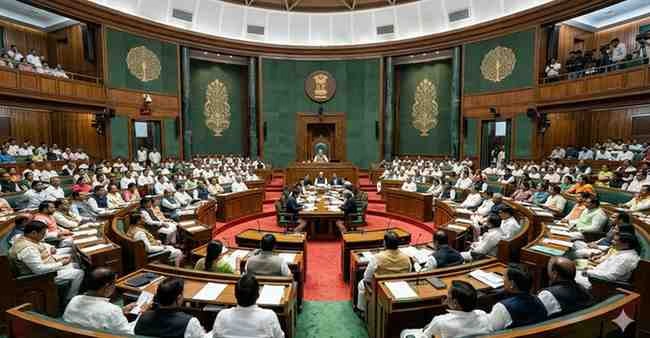
Delimitation Bill 2026 has become one of the most debated political developments in India. The bill aimed to redraw electoral boundaries and increase representation in the Lok Sabha, but it triggered a nationwide constitutional and political debate. What started as a reform proposal quickly turned into a clash between democratic equality and federal balance.
The Delimitation Bill 2026 was introduced alongside the Constitution (131st Amendment) Bill. Its main goal was to reorganize parliamentary constituencies based on updated population data and increase Lok Sabha seats from 543 to 850.
However, the constitutional amendment failed to secure the required two-thirds majority in Parliament. As a result, the government withdrew the Delimitation Bill, as both were closely connected.
There is no strong legal or constitutional reason to delay giving women 33% reservation in Parliament based on the current number of seats. This change could be implemented right now.
However, instead of doing that, the government introduced the proposal in a way that felt like a “Buy One, Get One Free” deal. This means the offer came with extra conditions that many people, especially those who support federal principles, found unacceptable.
The approach was rushed, similar to how demonetization was carried out — a quick decision without fully thinking through the long-term effects. Because of this, people fear that accepting these Bills would be like accepting a “political demonetization.”
In simple terms, this could reduce the power and representation of certain states. Especially those states that have already done well in areas like population control and human development might lose their fair share of political influence.
The government argued that the current system is outdated because it is still based on the 1971 Census.
States with higher populations like Uttar Pradesh have far more voters per MP
This creates inequality in representation
The bill aimed to use 2011 Census data as a temporary solution
It would also help implement 33% women’s reservation faster
From this perspective, the reform was necessary to ensure the principle of “one person, one vote.”
Opposition parties raised serious concerns about fairness and federalism.
Southern states like Tamil Nadu and Kerala could lose political influence
These states successfully controlled population growth
A population-based model could reward states with higher population growth
Critics warned this could create a “North-South divide” and allow certain regions to dominate national politics.
If the Delimitation Bill had been passed, the political balance in India would have shifted significantly.
Uttar Pradesh: Seats could rise from 80 to around 143
Bihar: Increase from 40 to about 79
Tamil Nadu: Smaller relative growth, reducing influence
Kerala: Minimal or no increase
This shows how population-based redistribution could significantly change political power across regions.
The bill ultimately failed because:
It did not achieve the required two-thirds majority
Strong opposition from regional parties
Concerns over federal imbalance
Lack of consensus on population-based representation
After the failure, the government withdrew the Delimitation Bill to avoid further political conflict.
ALSO READ | Delimitation Bill 2026: What It Means for Lok Sabha Seats, States and Women’s Reservation
With the bill withdrawn, India faces uncertainty regarding electoral reforms.
The freeze on seats (based on earlier amendments) continues
The upcoming Census in 2027 may play a key role
Women’s Reservation could be delayed
New ideas like a “weighted representation formula” may emerge
The issue is far from over and will likely return in future political debates.
The Delimitation Bill 2026 highlights a complex challenge in Indian democracy—balancing equal representation with fairness among states. While the bill aimed to modernize the electoral system, it also exposed deep regional and political divides.
The future of delimitation will depend on finding a solution that respects both population realities and the spirit of federalism.