
Delimitation Bill 2026 has become one of the most important political developments in India this year. The proposed law aims to redraw constituency boundaries, increase the total number of Lok Sabha seats, and reshape representation across states and Union Territories. It is officially linked to the Constitution 131st Amendment Bill and could have a long-term impact on Parliament, federal balance, and women’s political representation.
Introduced in April 2026, the bill is being seen as a landmark step because it does not just change seat numbers. It also restarts the process of redistribution that had remained frozen for decades. Supporters say the reform is necessary to reflect India’s changing population. Critics, however, fear it may reduce the political weight of some states that controlled population growth more effectively than others.
The Delimitation Bill is a legislative proposal to redraw parliamentary constituencies and reallocate Lok Sabha seats based on updated population data. In simple words, it is about deciding how many MPs each state and Union Territory will have and where constituency boundaries will be drawn.
The bill seeks to amend Articles 81 and of the Constitution. These changes would remove the long-standing freeze on seat redistribution that has existed since . For many years, the number of seats was effectively tied to the Census. Now, the government wants to allow new allocation using updated data.
ALSO READ | India’s Current Economic Situation in 2026 Strong Growth, Low Inflation, and Key Risks
The bill includes several major structural changes:
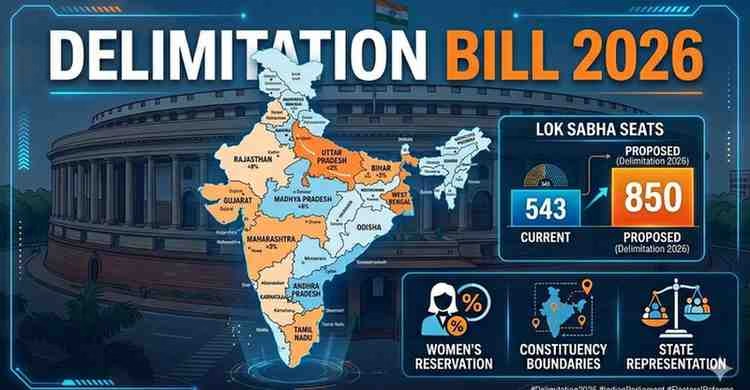
The total Lok Sabha strength will rise from seats to 850 seats.
Out of these, seats will go to states.
Another seats will be assigned to Union Territories.
Constituency boundaries across the country will be redrawn.
Reserved seats for SC, ST, and women will be identified after the delimitation process.
This expansion would be one of the biggest reforms in India’s parliamentary structure since independence.
The seat freeze was originally meant to encourage population control. States that successfully reduced population growth did not want to lose political representation compared with faster-growing states. Because of this, the number of parliamentary seats remained frozen for decades.
The new Delimitation Bill changes that arrangement. It opens the door for redistribution based on more recent population patterns. While a fresh Census began on April 1, 2026, the bill allows the Census to serve as an immediate base until the Census data is fully processed.
This temporary use of older data is meant to prevent delays, but it has also added to the debate.
The bill provides for a new Delimitation Commission. This body will play the central role in implementing the reform. Its responsibilities will include:
Deciding the number of seats for each state and Union Territory.
Redrawing the physical boundaries of constituencies.
Marking which seats will be reserved for Scheduled Castes and Scheduled Tribes.
Identifying seats for women under the reservation framework.
In practice, this means the commission will shape the future electoral map of India.
One of the most important political aspects of the Delimitation Bill is its direct link to women’s reservation. The Women’s Reservation Act passed in , but its implementation depends on completion of delimitation.
That makes this bill a trigger for women’s reservation in Parliament. Once delimitation is completed, reserved seats for women can finally be notified. So, the bill is not only about boundaries and numbers; it is also about opening the way for greater gender representation in Indian politics.
The bill has triggered a strong national debate, especially between northern and southern states.
Southern states such as Tamil Nadu and Telangana have raised concerns that slower population growth could weaken their share in national representation. Their argument is simple: states that invested in education, health, and family planning should not be politically penalized.
On the other hand, the Centre has assured that no state will lose its current proportional strength. According to the government, the large increase in total seats is designed to protect existing interests while still improving representation. Officials have suggested that the expansion is broad enough to avoid direct losses and create a more balanced system.
Still, critics remain cautious because even if the number of MPs rises in a state, its overall share in Parliament may still decline.
Odisha has also entered the debate in a serious way. Naveen Patnaik, as Leader of Opposition, wrote to Odisha Chief Minister Mohan Charan Majhi and urged strong opposition to the Constitution Bill and Delimitation Bill 2026.
According to the concerns raised, Odisha’s number of MPs may increase from to . At first glance, this looks like a gain. But the state’s share in the Lok Sabha would reportedly fall from to . This has been described as unfair to a state that performed well in population control and human capital development.
Patnaik supported women’s reservation and highlighted the empowerment legacy of the Biju Janata Dal. However, he argued that Odisha should accept delimitation only if its proportional rights are protected. He also called for a special Assembly session within 48hours to pass a resolution in defence of the state’s interests.
Appeal Hon’ble Chief Minister Shri @MohanMOdisha ji take up the issue of the Constitution (One Hundred and Thirty-First Amendment) Bill, 2026, the Delimitation Bill, 2026 strongly as it will take the voice of #Odisha and redistribute in other states. This will be a huge blow to… pic.twitter.com/Kkil2hfEz1
— Naveen Patnaik (@Naveen_Odisha) April 15, 2026
This issue is likely to become politically significant in Odisha because it connects representation, development, and regional pride.
Another major point of criticism is the proposed legal framework. Earlier, constitutional changes related to delimitation required a two-thirds majority. The new system is seen by critics as an attempt to streamline certain future adjustments through a simple parliamentary majority.
Opposition parties say this could weaken constitutional safeguards and allow major electoral changes without broad consensus. Supporters argue the change would make the process faster and more practical. This difference in opinion has become one of the most sensitive parts of the bill.
If passed, the Delimitation Bill could change Indian politics in several ways:
Parliament will become much larger, with Lok Sabha seats.
Representation will shift according to updated demographic realities.
Women’s reservation can move from legal promise to actual implementation.
States may see changes in their relative influence at the national level.
Regional political debates may intensify, especially over fairness and federal balance.
For ordinary citizens, the most visible result may be new constituency boundaries and different political equations during future elections.
The Delimitation Bill 2026 is more than a technical reform. It is a major political and constitutional moment that could redefine how India is represented in Parliament. While the government presents it as a step toward fairer and wider representation, several states and opposition leaders fear that the new system may reward population growth and weaken states that performed better on social indicators.
As Parliament prepares to debate the proposal, the discussion is likely to remain intense. The final shape of the law will matter not only for seat numbers but also for the balance between states, the future of women’s reservation, and the nature of Indian democracy itself.