

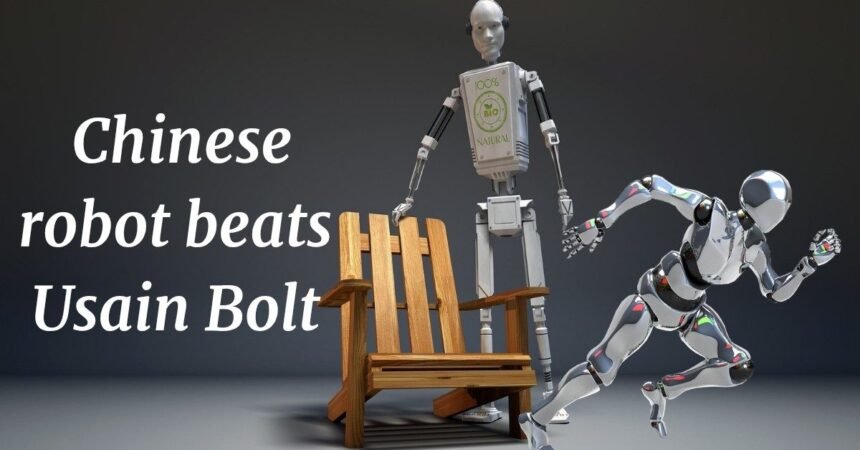
In a moment that felt more like science fiction than sports history, a Chinese robot beats Usain Bolt’s legendary 100-metre world record. On 22 August 2026, at the World Humanoid Robot Games in Beijing, a machine named Tiangong Ultra crossed the finish line in just 9.39 seconds. Usain Bolt’s human record of 9.58 seconds, set in 2009, had stood untouched for 17 years. Two robots finished faster than the greatest sprinter the world has ever seen.
- How a Chinese Robot Beats Usain Bolt in Front of the World
- Why This Moment Matters More Than Any Sports Record
- The Technology Behind the Speed
- China Leads the Humanoid Robot Race
- What This Means for Human Athletes and Sports
- The Bigger Picture: Robots Entering Everyday Life
- Challenges That Still Remain
- Ethical and Social Questions
- Looking Ahead: What Comes After 9.39 Seconds
- A New Chapter in Human Progress
This was not a quiet laboratory test. It happened in front of a live crowd, cameras, and global media. The race was part of the official opening of the second World Humanoid Robot Games. More than 2,000 humanoid robots from hundreds of teams competed across different events. What the world witnessed was not just a faster machine. It was a clear signal that the age of human physical supremacy in speed is ending.
How a Chinese Robot Beats Usain Bolt in Front of the World
The race took place at the National Speed Skating Oval in Beijing. Tiangong Ultra, developed by the Beijing Humanoid Robot Innovation Center, started strong but fell slightly behind early. A rival robot called Lightning, built by smartphone maker Honor, led for most of the race. Near the finish line, Tiangong Ultra surged ahead and stopped the clock at 9.39 seconds. Lightning finished in 9.47 seconds. Both times beat Bolt’s mark.
The robots did not celebrate. They slammed into thick protective mats designed to stop them. Tiangong Ultra stumbled sideways after the finish. The moment was raw, mechanical, and strangely powerful. Last year, the same Tiangong Ultra won the 100 metres in 21.50 seconds. In twelve months, the machine improved by more than 12 seconds. That kind of progress is almost unheard of in human sport.
Organisers confirmed the results. State media and international outlets, including Reuters, reported the times. A preparatory test even showed Lightning running 100 metres in 9.32 seconds, with a peak speed of 14.5 metres per second. For comparison, Bolt’s peak speed during his record run was around 12.4 metres per second.
Why This Moment Matters More Than Any Sports Record
When a Chinese robot beats Usain Bolt, the story is no longer only about athletics. It is about technology catching up to — and then surpassing — the limits of the human body. Human sprinters train for years. They manage diet, recovery, biomechanics, and mental focus. A robot can be upgraded overnight. Software updates, stronger actuators, better balance algorithms, and lighter materials can deliver improvements that take humans decades.
This event shows how quickly humanoid robots are advancing. China has made humanoid robotics a national priority. The government and private companies are pouring money into research. The goal is not just to win races. The goal is to build machines that can walk, run, climb stairs, lift objects, and work alongside people in factories, warehouses, hospitals, and homes.
The World Humanoid Robot Games are designed to showcase this progress. Events include sprinting, long-distance running, jumping, and even team sports. In April 2026, the same Lightning robot won a half-marathon in Beijing in 50 minutes and 26 seconds — faster than the elite human world-record pace. These results are not isolated stunts. They are part of a larger pattern.
The Technology Behind the Speed
What makes a robot run this fast? Several systems work together.
First, the actuators — the motors that move the joints — must deliver high power without overheating. Second, the control software must keep the robot balanced at high speed. Running is essentially controlled falling. Humans do this instinctively. Robots must calculate every step in real time using sensors and artificial intelligence.
Third, materials matter. Lightweight frames, strong carbon composites, and efficient batteries allow the robot to move quickly without carrying excess weight. Fourth, the feet and ground contact systems must absorb impact and push off efficiently. Human legs have evolved for this over millions of years. Engineers are now copying and improving on that design.
Tiangong Ultra’s rapid improvement from 21.50 seconds to 9.39 seconds shows how fast these systems are evolving. Last year’s model was slower and less stable. This year’s version is clearly more powerful and better controlled. Experts expect even faster times in the next two years.
China Leads the Humanoid Robot Race
China is currently the clear leader in public demonstrations of humanoid robot athletics. The United States has strong companies working on humanoid robots for industrial use, but China is winning the publicity battle with these high-profile events. The World Humanoid Robot Games attract global attention and send a message: Chinese robotics is advancing at remarkable speed.
This has economic and strategic importance. Countries that master humanoid robots may gain advantages in manufacturing, logistics, elderly care, and even defence. Robots that can run, jump, and navigate complex environments could one day perform tasks that are dangerous or difficult for humans. The ability to produce such machines at scale could reshape global supply chains.
Meanwhile, other countries are observing the situation carefully. The United States, Japan, South Korea, and European countries all have advanced robotics programmes. The difference is that China is using public competitions to prove progress in a very visible way. When a Chinese robot beats Usain Bolt on the world stage, it creates a powerful narrative of technological leadership.
What This Means for Human Athletes and Sports
Some people worry that robots will make human sport less meaningful. That fear is understandable but probably overstated. Human competition is not only about absolute speed. It is about effort, drama, personality, and the limits of the human body under pressure. Fans connect with athletes because they are human. A robot that runs 9.39 seconds does not feel pain, doubt, or joy in the same way.
Still, the comparison is useful. It forces us to ask new questions. How should we measure athletic achievement in a world where machines can outperform us? Will future sports have separate categories for humans and robots? Will training methods change when we see how efficiently machines move?
For now, human records remain human records. Bolt’s 9.58 seconds is still the fastest time ever run by a person. The robot’s time belongs in a different category. But the psychological impact is real. For the first time, the fastest 100 metres ever recorded was not run by a human.
The Bigger Picture: Robots Entering Everyday Life
The race in Beijing is exciting, but the real story is what comes next. Companies around the world are building humanoid robots for practical work. Factories need workers who can handle repetitive or heavy tasks. Warehouses need machines that can walk between shelves and pick items. Hospitals may one day use robots to help move patients or deliver supplies. Homes could have robots that assist elderly people with daily activities.
Speed is only one capability. Balance, strength, dexterity, and intelligence matter more for real-world use. A robot that can run 100 metres in under 10 seconds proves that the legs and control systems are advanced. The same technology can be adapted for slower, more careful movements in workplaces.
China’s focus on humanoid robots is part of a larger industrial strategy. By mastering these machines, Chinese companies hope to lead in the next generation of automation. Other countries will have to respond if they want to stay competitive.
Challenges That Still Remain
Despite the impressive times, humanoid robots still face major challenges. Battery life is limited. A robot that sprints 100 metres may not be able to work for eight hours without recharging. Reliability is another issue. Machines can break down or lose balance in unexpected ways. Safety is critical when robots work near people. A powerful robot that falls or collides can cause serious injury.
Cost is also high. Advanced humanoid robots are expensive to design and build. For them to become widespread, prices must come down. Software must become more robust. Robots need to handle rain, uneven ground, stairs, and crowded spaces. The Beijing race happened on a prepared track. Real life is far messier.
Engineers know these problems. Progress is happening on all fronts. Better batteries, stronger materials, smarter AI, and cheaper production methods are all under development. The leap from 21.50 seconds to 9.39 seconds in one year shows how quickly solutions can appear.
Ethical and Social Questions
When machines outperform humans in physical tasks, society must think carefully. Will robots take jobs that people currently do? How should we regulate powerful machines? Who is responsible if a robot causes harm? These questions are not new, but events like the Beijing race make them more urgent.
There is also a cultural question. Humans have always celebrated physical excellence. From ancient Olympic Games to modern world championships, speed and strength have been sources of pride. Seeing a machine do better can feel unsettling. At the same time, humans have always used tools to extend their abilities. Cars are faster than runners. Planes fly higher than birds. Robots that run may simply be the next tool.
Also Read | How to Set Up WhatsApp Business with a Landline Number: Easy Step-by-Step Guide
The difference is that humanoid robots look and move like us. That similarity creates a stronger emotional reaction. A car does not threaten our sense of what it means to be human in the same way a running robot does.
Looking Ahead: What Comes After 9.39 Seconds
The 9.39-second run will not be the final word. Future robots will be faster, more stable, and more energy-efficient. We may see times under 9 seconds within a few years. Other events will follow — longer distances, obstacle courses, team competitions, and more complex challenges.
The World Humanoid Robot Games will likely grow in size and importance. More countries and companies will send teams. Media coverage will increase. Public interest in robotics will rise. Young people may become inspired to study engineering, AI, and related fields after watching these machines compete.
For China, the event is a soft-power success. It shows technological capability in a memorable way. For the rest of the world, it is a wake-up call and an opportunity. Collaboration and competition will both increase. Research will accelerate.
A New Chapter in Human Progress
When a Chinese robot beats Usain Bolt, something fundamental shifts. For the first time, the absolute speed record no longer belongs to a human being. That fact will be remembered for a long time. It marks the point where machines clearly surpassed us in one of our most celebrated physical skills.
Yet this is not a story of human defeat. It is a story of human achievement. Every part of that robot was designed, built, programmed, and improved by people. The intelligence that created Tiangong Ultra is human intelligence. The curiosity that drives these competitions is human curiosity. The desire to push limits is a human desire.
We built machines that can run faster than we can. That is remarkable. What we do with that ability will define the next decades. Will we use humanoid robots to free people from dangerous and repetitive work? Will we create new sports, new forms of entertainment, and new ways of living? Or will we struggle with job losses, safety risks, and ethical dilemmas?
The answer depends on the choices we make now. The 9.39-second run is only the beginning. The real race is not between robots and Usain Bolt. It is between our ability to innovate and our ability to guide that innovation wisely.
The finish line is still far ahead. And this time, both humans and machines are running toward it together.