

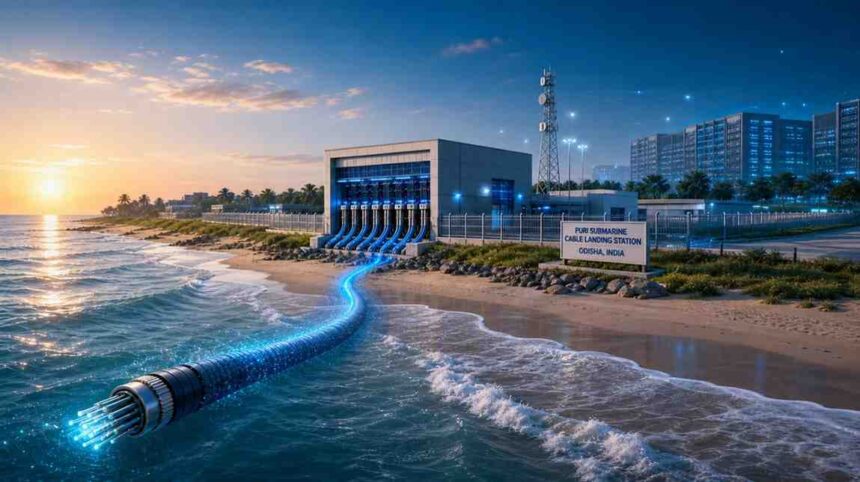
Puri Submarine Cable Landing Station is emerging as a major digital infrastructure project that could reshape how Odisha connects with the world. The plan is to build a high-capacity international connectivity gateway for eastern India and improve internet and data access across the region.
For a long time, Odisha has been seen as a state with strong potential in technology and digital services. Now, with the proposed cable landing station in Puri, that potential may finally move closer to reality.
The project aims to connect Bhubaneswar directly with Singapore through subsea fibre-optic infrastructure, which could significantly improve global connectivity for Odisha. This matters because faster international links can reduce latency, improve internet performance, and support digital businesses that depend on real-time data movement.
In simple words, lower latency means less delay when data travels from one place to another. For sectors such as fintech, gaming, cloud computing, AI services, and digital platforms, that can make a real difference in speed and user experience.
The project is no longer just an idea on paper. Officials and stakeholders have already pointed to several important steps, including an MoU with RailTel Corporation of India, approval of the Detailed Project Report, global tenders for fibre systems and networking equipment, and a fast-track execution target of around three years.
Reports also show that RailTel has been involved in planning work, while Odisha’s government has been pushing the project as part of a larger digital growth strategy. Puri was identified as a suitable location because of its strategic position, coastline, existing infrastructure, and room for future scale.
What Odisha could gain
One of the most important features of the proposed station is that it is expected to work as a carrier-neutral hub, which means multiple telecom and internet companies could use the same infrastructure. That kind of open access can make the ecosystem more competitive and more attractive for future network expansion.
The bigger opportunity is economic. Industry observers believe the project could attract hyperscale data centres, Global Capability Centres, cloud infrastructure companies, and broader technology investment into Odisha. If that happens, the cable landing station may not only improve internet quality but also help create a stronger digital economy around jobs, innovation, and enterprise growth.
Odisha’s move shows that digital infrastructure is no longer just about cables and networks. It is increasingly about building the foundation for future business, smarter services, and global competitiveness. If the Puri project moves ahead on schedule, it could become one of the most important digital turning points for eastern India.