
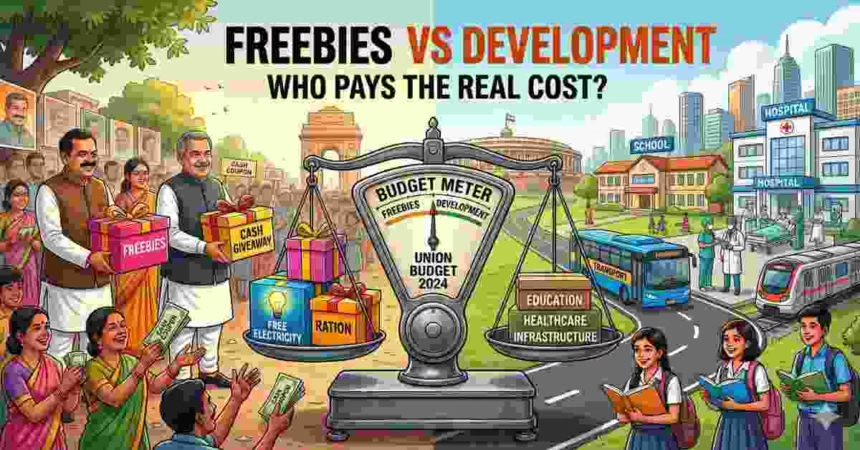
Freebies have become one of the biggest political and economic debates in India today. Many people welcome free electricity, cash support, transport benefits, or consumer goods because these offers bring quick relief, especially to poor families. But a serious question also arises: if governments keep spending heavily on freebies, how will the country fund education, schools, transport, hospitals, and other necessary services that build the future?
India is a welfare state, and helping the poor is not wrong. In fact, support for food, health, education, and child nutrition is often necessary because these areas improve human capability and social justice over time. The problem begins when public money is used mainly for short-term political gain instead of long-term public benefit.
Why freebies matter
The debate is not really about whether the government should help people. The real issue is the difference between useful welfare and non-productive freebies. In the material you shared, welfare schemes such as health, schooling, sanitation, and nutrition are treated as investments in people, while many freebies are described as short-term handouts that may bring electoral appeal but do not always create lasting value.
For example, a midday meal in a school can improve attendance, reduce hunger, and support learning. That kind of spending helps a child today and also strengthens the country tomorrow. But if money is spent on items that do not improve skills, health, productivity, or infrastructure, then the public may get temporary satisfaction without long-term progress.
This is why the freebies debate is so important. Government money is limited, and every rupee spent in one place cannot be spent somewhere else. If too much money goes into unplanned giveaways, there is less space for classrooms, teachers, ambulances, roads, public transport, hospital equipment, clean water, and job-creating infrastructure.
Freebies and public services
Education, health, and transport do not run on promises alone. They need regular investment, proper planning, trained staff, maintenance, and strong public institutions. A school needs buildings, toilets, teachers, digital tools, books, and scholarships. A hospital needs doctors, nurses, medicines, beds, testing facilities, emergency care, and reliable power. Transport needs buses, roads, bridges, fuel support, repair systems, and safety management.
When a state budget becomes overloaded by subsidies and recurring giveaways, these core areas can suffer. The article you shared explains that high committed expenditure and large subsidy burdens reduce “fiscal space,” which means states have less flexibility to spend on development. This is one of the biggest dangers of freebies: they may look helpful in the short term, but over time they can weaken the systems that citizens depend on every day.
Think of it like a family budget. If a family spends most of its income on short-term celebrations and gifts, it may later struggle to pay school fees, hospital bills, or house repairs. A government works in a similar way, only at a much larger scale.
How debt grows
According to The Indian Express The Reserve Bank of India warned in its 2022 risk analysis that Bihar, Kerala, Punjab, Rajasthan, and West Bengal were among the most fiscally stressed states because of high debt and deficit concerns. Your attached table also shows Punjab with a debt-to-GSDP ratio above 49 percent and a very high interest-payment burden, while Himachal Pradesh is shown as having very high per-capita debt stress.
Why does this matter for common people? Because when a state borrows too much, it must spend more of its yearly income on repaying old loans and interest. Once that happens, less money remains for new schools, hospital buildings, better roads, public transport, or employment-linked development projects.
The text also mentions the Interest Payment to Revenue Receipt ratio as a warning sign of stress. When this ratio rises too much, a growing part of government revenue is used only to service debt instead of creating new public assets. In simple terms, the government starts paying for yesterday instead of investing in tomorrow.
ALSO READ | India’s Current Economic Situation in 2026 Strong Growth, Low Inflation, and Key Risks
Freebies vs growth
One of the strongest arguments in your source is that heavy freebie spending can crowd out capital expenditure. Capital expenditure means spending on long-term assets like roads, bridges, irrigation, industry support, public transport networks, hospitals, and schools. This kind of spending creates lasting value and supports future growth.
Research cited by NIPFP says that ₹1 spent on capital expenditure can create around ₹2.45 in GDP impact, while transfer payments and other revenue expenditure have much lower multipliers, around 0.98 to 0.99. That means the quality of spending matters as much as the amount of spending.
If a government spends more on productive assets, people get jobs, markets improve, transportation becomes easier, and businesses expand. But if spending mostly goes into non-productive freebies, the benefit may end quickly while the financial burden remains for years. This is exactly why the question in your article is so powerful: how will education, schools, transport, and hospitals work if large public funds are consumed by giveaways?
Why some support is necessary
At the same time, the answer is not to reject every subsidy or welfare scheme. The material clearly shows that some government support is necessary and justified, especially in a country with inequality and poverty. Free or affordable food, school meals, basic healthcare, targeted farm support, scholarships, and support for vulnerable groups can improve dignity, productivity, and opportunity.
So the real issue is targeting and purpose. If public money helps children study, mothers access healthcare, workers travel safely, or poor families survive inflation, that is meaningful welfare. But if spending is designed mainly to win elections without creating lasting social value, then it becomes risky for the economy and unfair to future generations.
That distinction is very important for voters too. Citizens often see the immediate benefit of a free service, but they may not always see the hidden cost: poor roads, fewer teachers, delayed salaries, unfinished hospitals, weak public transport, and growing debt.
Lessons from states
Punjab is one of the clearest examples discussed in the source. Decades of free or highly subsidized electricity, especially in agriculture, created a burden that is now hard to reverse politically, while also contributing to groundwater overuse and pressure on the state budget. The article says Punjab’s annual power subsidy bill has become so large that it has reduced room for other essential spending.
Himachal Pradesh is another warning sign. The text says debt rose sharply there, and fiscal stress became so serious that the government faced difficulty in paying employees and pensioners on time. When a state begins struggling with salaries and pensions, it shows how weak public finances can affect the entire administration, including schools, hospitals, and public services.
These examples show that the risk is not theoretical. When finances become unstable, development slows and public trust weakens.
A better path for India
The better approach is not “no welfare,” but “smart welfare.” The source strongly supports targeted support, stronger financial discipline, and a shift from leakage-prone subsidies to efficient delivery systems like Direct Benefit Transfer. Recent reporting on the BlueKraft assessment says India’s DBT system helped generate cumulative savings of ₹3.48 lakh crore by reducing leakages and removing fake beneficiaries.
This is an important lesson. If welfare is targeted well, the poor can still receive support while governments save money for schools, hospitals, roads, transport, and development. In other words, good governance is not about stopping help; it is about making sure help reaches the right people in the right way.
India also needs stronger oversight of election promises, regular review of subsidy schemes, more awareness among voters, and more focus on capital expenditure. If states are rewarded for building assets and improving public services, then welfare and development can move together.
In Summary Freebies may offer quick happiness, but they cannot replace strong public systems. A nation becomes stronger not when it gives away the most, but when it builds the best schools, hospitals, roads, transport, water systems, and opportunities for its people.
If governments spend without limits, the burden appears later through debt, weaker services, and lost development. But if governments choose targeted welfare, efficient DBT delivery, and long-term investment, then India can support the poor and still build a better future for everyone.