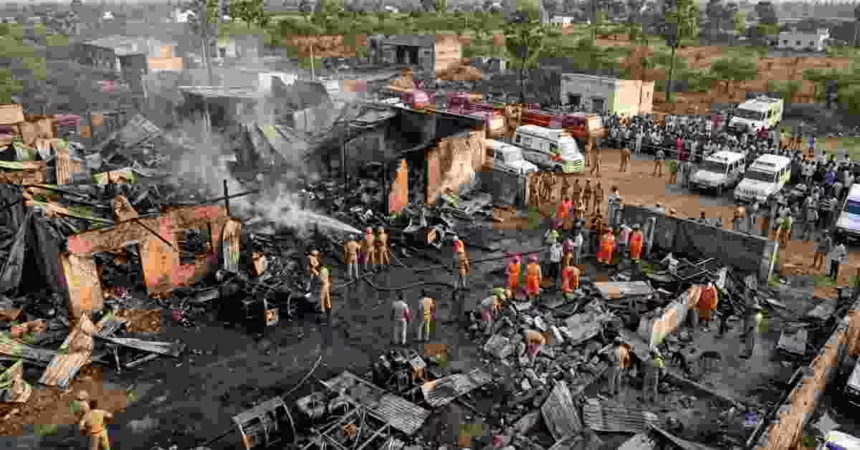
VIRUDHUNAGAR, TAMIL NADU — In a devastating reminder of the persistent safety hazards within India’s firecracker industry, at least 23 workers were killed and eight others seriously injured following a massive explosion at a fireworks manufacturing unit on Sunday afternoon. The Virudhunagar Fire incident occurred at the Vanaja Fireworks Unit in Kattanarpatti village, located near the industrial hub of Virudhunagar in southern Tamil Nadu.
The blast, which took place April 19, 2026, was so powerful that the tremors were reportedly felt up to 10 kilometers away. Preliminary reports suggest that the initial explosion triggered a chain reaction, leveling at least four manufacturing sheds and reducing them to rubble within seconds.
While the fireworks industry in the region typically remains closed on Sundays, investigators revealed that the ill-fated unit was operating without permission at the time of the accident. Over 40 laborers, including many women, were reportedly engaged in the mixing of chemicals and the final assembly of crackers to meet high seasonal demand.
District officials stated that the explosion likely originated in the chemical mixing room—the most sensitive area of any fireworks factory.
“Preliminary investigations suggest that friction during the handling of raw chemicals may have triggered the first spark,” noted a senior fire official. “Because the workers were crowded in areas not designated for assembly, the casualty rate was tragically high.”
The force of the detonation was so immense that several victims were charred beyond recognition. Emergency responders arriving at the scene were met with a gruesome sight, as mutilated body parts were found scattered across the facility’s premises and in adjacent fields.
Second Explosion During Rescue Operations
The tragedy was compounded later in the evening when a second explosion occurred during rescue and recovery efforts. Earthmover was clearing debris to reach trapped workers, a cache of buried chemicals ignited.
This secondary blast in Virudhunagar Fire accident injured 17 additional people, including six policemen and four firemen who were leading the search. The chaos that followed saw high-ranking officials, including the District Collector and Superintendent of Police, forced to take cover as unexploded materials continued to detonate intermittently throughout the night.
READ ALSO: https://infodean.com/freebies-and-development-india/
Victims and Medical Response
The deceased have been identified primarily as residents of nearby villages, including Servaikaranpatti and Thiruthangal. Among the dead were several couples and long-time laborers who had worked in the industry for decades.
The eight primary injured in Virudhunagar Fire accident survivors were rushed to the Virudhunagar Government Medical College Hospital. Doctors have reported that at least two individuals remain in critical condition with over 80% burn injuries. A 12-year-old child, who was reportedly playing near the unit while his parents worked, was also among those injured.
Political and Official Reactions
Prime Minister Narendra Modi expressed his deep condolences via social media, describing the mishap as “deeply distressing.” He announced an ex-gratia payment for the families of the deceased and wished for the swift recovery of the injured.
Tamil Nadu Chief Minister M.K. Stalin immediately dispatched senior ministers K.K.S.S.R. Ramachandran and Thangam Thennarasu to the site to oversee the relief operations. The state government has ordered a high-level inquiry into the incident, focusing on:
How the factory was operating on a prohibited day (Sunday).
Violations of the Petroleum and Explosives Safety Organisation (PESO) guidelines.
The presence of more workers than the legally permitted limit for the facility’s license.
The Cost of Negligence
This disaster is the deadliest industrial in the Virudhunagar Virudhunagar Fire accident-Sivakasi belt so far this year. The region, often referred to as India’s “Firecracker Capital,” has a long and troubled history with factory fires. Despite frequent safety audits and the implementation of “Green Cracker” regulations, local activists argue that many units continue to bypass safety protocols to maximize profit.
“For a unit licensed by the District Revenue Officer, the limit is usually 12 workers,” a local industry expert commented. “The fact that 23 people died in a single blast proves that safety norms were flagrantly ignored.”
As search teams continue to sift through the charred remains of the Vanaja Fireworks Unit, the local community is left mourning. This latest tragedy once again raises urgent questions about the enforcement of industrial safety laws and the high human cost of the world’s appetite for celebration.