
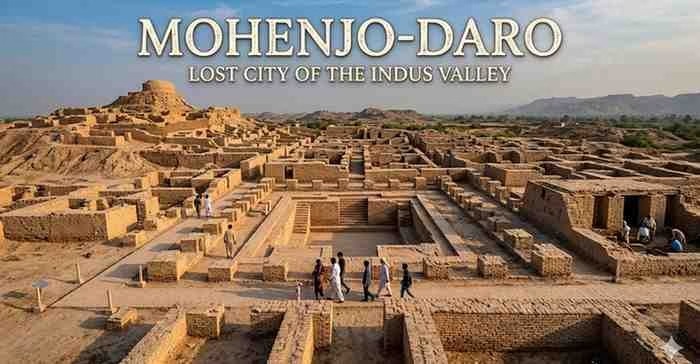
Mohenjodaro stands as one of the most remarkable archaeological discoveries in human history. Located in present-day Pakistan, this ancient city was a major center of the Indus Valley Civilization around 2500 BCE. Mohenjodaro, meaning “Mound of the Dead,” offers deep insights into early urban life, engineering excellence, and cultural sophistication.
Mohenjodaro was not just any settlement—it was a highly planned urban center. The city was designed using a grid system, with streets intersecting at right angles. This organized layout reflects a level of civic planning that was far ahead of its era.
The buildings were constructed using standardized baked bricks, ensuring durability and uniformity. Houses often included multiple rooms, inner courtyards, and private wells, indicating a well-developed lifestyle. Some structures even had upper floors, showcasing architectural advancement rarely seen in ancient times.
One of the most striking features of Mohenjodaro is its sophisticated drainage system. Nearly every house was connected to covered drains that ran beneath the streets. These drains were carefully constructed to ensure efficient waste disposal, emphasizing cleanliness and public hygiene.
Such an advanced sanitation system demonstrates the importance placed on urban management and health, making Mohenjodaro one of the earliest examples of modern city planning
The Great Bath is one of the most iconic structures in Mohenjodaro. This large rectangular pool, built with watertight bricks and bitumen, was likely used for religious or ritual purposes. It highlights the cultural and spiritual practices of the people.
The presence of such a structure indicates that water played a central role in community life, possibly symbolizing purity and social unity.
Mohenjodaro was part of a thriving trade network. Archaeologists have discovered seals, beads, and standardized weights, suggesting active trade with distant civilizations such as Mesopotamia.
The uniformity in weights and measures indicates a regulated economy and possibly a strong administrative system. This points to a society that was not only economically vibrant but also well-governed.
ALSO READ | SSC GD Constable Your Gateway to a Prestigious Career in Paramilitary Forces
Despite its success, Mohenjodaro declined around 1900 BCE. The exact reason remains unknown, adding an element of mystery to its history. Scholars have proposed several theories, including floods, climate change, and shifting river courses.
While no single explanation has been confirmed, the decline of Mohenjodaro continues to intrigue historians and researchers worldwide.
Today, Mohenjodaro is a UNESCO World Heritage Site and a symbol of ancient innovation. Its well-planned infrastructure, advanced engineering, and cultural richness challenge the perception of early civilizations as primitive.
The city serves as a reminder that thousands of years ago, humans were capable of building organized, sustainable, and intelligent urban environments.
Mohenjodaro is more than just an ancient ruin—it is a testament to human ingenuity and progress. From its advanced drainage systems to its structured urban layout, Mohenjodaro continues to inspire modern urban planning and historical curiosity.
Understanding Mohenjodaro helps us appreciate the depth of ancient civilizations and provides valuable lessons for the future of city development.